Disclaimer: The following is written to provide a very general basic outline of the procedures involved in recertifying as a pilot and obtaining employment and permanent resident residency in the United States. It is meant to be only a general description and outline of a very detailed process. Do Not Rely on the information which follows for instructions, nor as constituting legal advice.
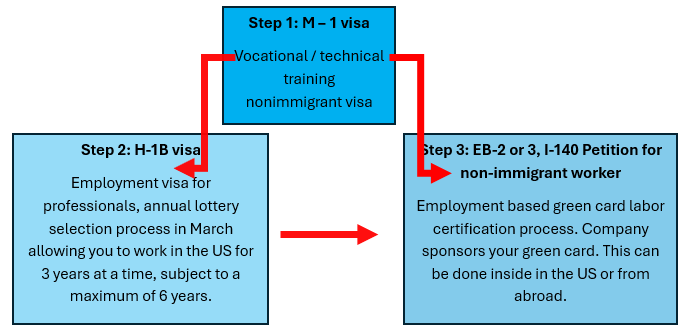
The immigration process to work and live in the USA as a pilot, is a journey. Below maps a possible route for pilots who may not necessarily qualify for “exceptional ability” visa processes, and breaks down the process into strategic steps:
1. Flight school attendance:
You will have to attend flight school in the USA to recertify. Your duration of study will depend on your level of experience and qualifications. The timeline for completing flight training varies depending on individual schedules and proficiency, with programs typically lasting 4–6 months at SEVP-approved schools.
2. Obtaining an M-1 visa:
To be able to come to the USA to attend flight school required for recertification, you will be required to obtain an M-1 visa for non-academic vocational technical training. The M-1 visa is specifically for students enrolling in vocational or non-academic programs for a range of technical skills such as mechanical studies, or language training, unlike the F-1 visa which is for academic purposes only. Students will need to pay government filing fees to obtain the visa Form I-901 ($350) and DS-160 ($185) government fees during the visa application process.
Requirements to obtain an M-1 visa include:
- Enrollment as a full-time student in a vocational or non-academic program.
- Demonstrating English proficiency or be enrolled in English language courses.
- Proof of financial ability to support tuition and living expenses.
- Notably, students cannot work on an M-1 visa.
3. SEVP-Approved Program:
The program you attend must be approved by the Student and Exchange Visitor Program (SEVP). So, it is essential to check whether the flight aviation school you want to attend is SEVIS registered, before you enroll with them and pay any deposit. If they are enrolled, they will usually assist you to obtain the M-1 visa and will provide you with the I-20 you need to obtain the visa.
4. Foreign License Verification visa IACRA
To start this process, you will first create an account on the government website: iacra.com and follow instruction through starting a foreign license verification. Once you receive a response you need to attend an examination.
5. FAA Letter and In-Person Examination, and Certification to Fly:
The FAA will send you a letter within 90 days to confirm receipt of your documentation, and you will be advised to make an appointment with an examiner to process the verification of your documentation and existing certifications.
At the in-person meeting an examiner will assess the authenticity and credibility of your documentation and ensure your English proficiency.
6. Job offers and H-1B Visa sponsorship:
Once you are ‘certified to fly’ you can attempt to obtain a job offer with a sponsoring company. Your sponsoring company can simultaneously apply for a professional employment-based H-1B visa, and engage in the labor certification process which can take 2 -3 years, only then will you be allowed to work indefinitely for your sponsoring company i.e. after your petition of immigrant worker and your green card application is approved.
7. Labor Certification process.
The EB-3 labor certification, employment based green card process is the process in which a US employer demonstrates to the US Department of Labor that it has a regional job offer for a foreign worker, which will not displace qualified American workers, nor adversely affect wages and working conditions. The certification is obtained by the employer who files an “Application for Permanent Labor Certification” also known as a PERM.